
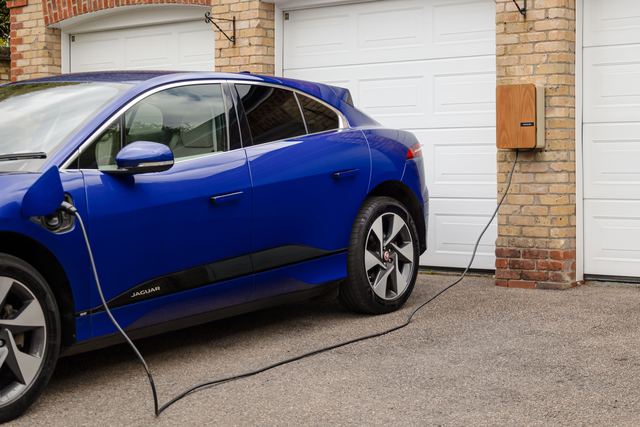
Portable cable or wall charger?
| Portable cable in a power point | Wall-mounted charger | |
|---|---|---|
| What's involved | Plugs into a power point you already have | A registered electrician fits it on its own sub-circuit |
| Speed | The slower option | Faster, Gen Less says |
| RCD protection | Whatever already protects that power point | A Type B RCD, or a charger with one built in |
| Suits | Light daily driving, or while you decide | Most daily drivers, two EVs, or scheduled off-peak charging |
Is a normal power point up to it?
Plenty of EV owners start with the cable that came with the car. The catch is the load: a steady, heavy draw for hours at a time, nothing like a kettle that runs for a couple of minutes.
WorkSafe's January 2026 addendum to its EV charging guidelines says a portable cable with a 32 A plug isn't in line with those guidelines, though the regulations don't ban it, and that it should warn that some homes may not reliably or safely supply a sustained 32 A load. If the plug or outlet gets warm while charging, stop using it for the car and get it checked.
What the electrician checks before you buy
Start with the switchboard. WorkSafe's addendum says a home charger's circuit should come from a MEN switchboard and be protected by a Type B RCD. An older board may have no room for one more circuit, which turns a charger job into a switchboard upgrade as well.
Next comes your supply. WorkSafe says a socket for a 32 A charger is allowed in a home, but the home's maximum demand has to be assessed, and it recommends some form of load management. That's a setting or sensor that eases the charger back when the oven, the heat pump and the hot water cylinder are all running at once.
The addendum also says that with advanced load management on a 32 A (7.5 kW) charger, enough charge for a typical day's driving is likely without increasing a typical home's peak use. For cars with a range of 350 km or more that need a full charge overnight, it says some upgrading of the installation wiring may be required.
Last comes the cable run from the board to the parking spot. Gen Less advises a separate sub-circuit with cable rated for the charger's output.
Why the type of RCD matters
An RCD (residual current device) cuts the power when current leaks, the job a test-button switch on your board does for ordinary circuits. WorkSafe's consumer guidance says a Type B RCD is the most appropriate kind for EV charging, because the common Type A may not protect against every fault a charger can produce.
There are accepted alternatives. WorkSafe's addendum allows an RDC-DD to IEC 62955 combined with a Type A RCD, and it doesn't restrict using a charger with a Type B RCD built in, without a second one on the circuit. Ask the electrician which arrangement they've chosen, and why.
The addendum also says every charging station must comply with IEC 61851 as appropriate. Gen Less gives buyers a simpler check: make sure the charger has a Supplier Declaration of Conformity (SDoC).
Does your lines company need to know?
Your lines company owns the network up to your property boundary; your retailer is who you pay for power. If your existing connection can't carry a charger, changing it goes through the lines company. Ask your electrician to check with yours before work starts. Not sure which company it is? Electricity Networks Aotearoa (ENA) has a map that finds it from your address.
Smart charging and off-peak power
According to Gen Less, a smart charger can shift charging into off-peak hours and that can lower costs. Smart scheduling and load management often come in the same charger, so ask about both when comparing models. Our home EV chargers page walks through the choices.
The certificates you should get
The Electrical Workers Registration Board (EWRB) sorts prescribed electrical work into low-risk, general and high-risk. A charger needs new wiring, and a new circuit is general work, so you should get a Certificate of Compliance (CoC) and an Electrical Safety Certificate (ESC).
If the job also needs a higher-capacity switchboard, that part is high-risk work: a licensed electrical inspector checks it independently and issues a Record of Inspection. Ask up front which risk level your job falls into and which certificates you'll get, then keep them with the house papers. Electrical certificates explained goes through each one.
What you can sort, and what's licensed
You can
- Decide where the car parks and which side its charge port is on.
- Check the charger you're considering has a Supplier Declaration of Conformity.
- Keep the portable cable where it won't be driven over.
Leave to a licensed electrician
- Fitting the charger and running its circuit. The EWRB says EV charging work isn't open to homeowners, even in a home they own and live in.
- The RCD, breaker and any other switchboard work.
- Assessing your maximum demand and setting up load management.
- Checking with the lines company if your supply needs to change.
What to ask a charger installer
- Which RCD arrangement will protect the circuit: a Type B, an RDC-DD with a Type A, or one built into the charger?
- Have you assessed our maximum demand, and will the charger have load management?
- Does my switchboard have room, or does it need work as well?
- Will you check with the lines company before you start?
- Which certificates will I get, and is any part of this high-risk work?
- Can I see your licence ID before the job begins?

Our take
If you drive most days, we'd skip the long-term power point plan and get a wall charger on its own circuit, with load management, from a sparky who fits chargers week in, week out. Buy the charger after the electrician has looked at your board and supply, not before. That one visit tells you if it's a simple circuit or a board upgrade too.
Want a specialist to sort it?
Tell us the job and your postcode. We match the licence-checked local electrician who does this kind of work, and they call you. No ring-around, and your number goes to them alone.