
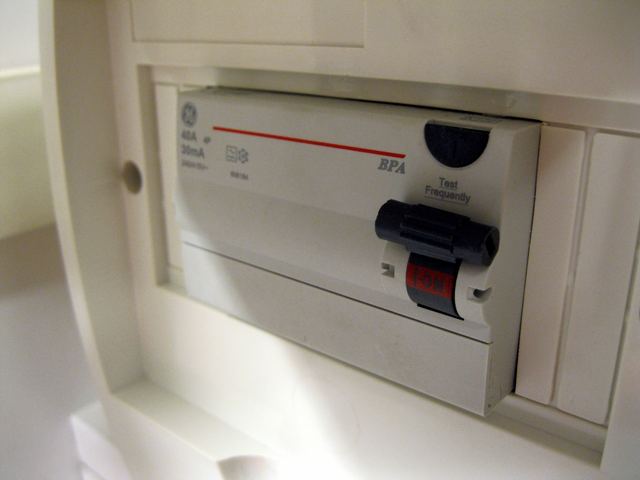
How an RCD differs from a circuit breaker
A circuit breaker protects the wiring. It trips when a circuit draws more current than its cable can safely carry, like too many heaters on one circuit, or when there's a short circuit.
An RCD protects people. It trips on a small leak to earth that a breaker would never notice, the kind that runs through someone holding a faulty drill or a damaged lead. Many newer boards use combined devices, often called RCBOs, that do both jobs for each circuit.
Old ceramic fuses do a breaker's job and nothing more. A board with only fuses has no protection against leakage at all, which is why old fuse boards are usually the first thing an electrician suggests replacing.
What the rules say
By WorkSafe's account, any new circuit in a home that runs from the switchboard to lights or power points has to be RCD-protected by law. A WorkSafe document from January 2026 also notes that the wiring rules, AS/NZS 3000, require RCD protection for new final subcircuits in a home.
Those rules are about new work. An older board without RCDs doesn't have to be upgraded just because the rules have moved on, since WorkSafe lets existing installations stay in use while they aren't unsafe. Adding RCDs is still one of the most useful safety upgrades an older home can get.
Replacing a faulty RCD is low-risk work and comes with an Electrical Safety Certificate. Adding RCDs as part of new circuits is general work, with a Certificate of Compliance too, and a higher-capacity board is high-risk work that also gets an independent inspection.
How to test your RCDs
Warn the household
Pressing the test button cuts power to everything that RCD covers, so save any work on the computer and expect to reset a few clocks.
Press the test button
Press it firmly. The RCD should trip straight away, with its switch dropping to off.
Switch it back on
Push the switch back up. If it won't stay on, or didn't trip when you pressed the button, call an electrician.
Make it a habit
Every few months is a sensible rhythm. Pairing it with a smoke alarm test makes it easy to remember.
When an RCD keeps tripping
An RCD that trips is usually doing its job. The common causes are a faulty appliance, water getting into an outdoor power point or light, or old wiring whose insulation is breaking down.
To narrow it down, unplug everything on that circuit, reset the RCD, then plug things back in one at a time. If it trips with nothing plugged in, the fault is in the fixed wiring and it's time for an electrician. Why the power keeps tripping walks through it, and the tripping troubleshooter asks the questions for you.
Never hold an RCD on, tape it up or ask anyone to bypass it. The trip is the warning. The fault behind it is the problem.
Type B RCDs and EV chargers
WorkSafe's consumer guidance says a Type B RCD is the most appropriate kind for charging an EV, because the common Type A may not catch every charger fault. Its January 2026 addendum says a home charger's circuit should be protected by a Type B RCD and come from a MEN switchboard, with an RDC-DD plus a Type A RCD accepted as an alternative.
The same guidance doesn't stop you using a charger with a Type B RCD built in, without a second one on the circuit. If an EV is on the way, plan the RCD and the charger installation together.
What you can do, and what's licensed work
You can
- Press each RCD's test button every few months and check it trips.
- Reset a tripped RCD once, after unplugging what's on that circuit.
- Use a plug-in portable RCD for outdoor power tools if the power point isn't protected.
- Label which RCD covers which rooms, so the next trip is easier to trace.
Leave to a licensed electrician
- Adding RCDs to an existing switchboard.
- Replacing a faulty RCD, with an Electrical Safety Certificate.
- Tracking down a leak to earth in the fixed wiring.
- Fitting a Type B RCD for an EV charger.
Questions to ask the electrician
- How many RCDs will there be, and which circuits will each one cover?
- If one circuit has a fault, how much of the house goes dark?
- Is there room on the board, or does the board need replacing?
- If the board is replaced, is it higher-capacity, and who's the inspector?
- Which certificate will I get?
Why the specialist matters
Adding RCDs to an old board is fiddlier than it looks. An electrician who upgrades boards every week tests the wiring for existing leaks first, because an RCD on a leaky circuit just trips all day. They'll also spread circuits across more than one RCD, so a wet garden light doesn't black out the whole house.

If it were our switchboard
If our board had no RCDs, we'd get them added before anything else on the wish list. If it has them, we'd test them every few months and treat a trip as information, not a nuisance. And if an EV is coming, we'd talk to the electrician about a Type B RCD at the same visit.
Want a specialist to sort it?
Tell us the job and your postcode. We match the licence-checked local electrician who does this kind of work, and they call you. No ring-around, and your number goes to them alone.