
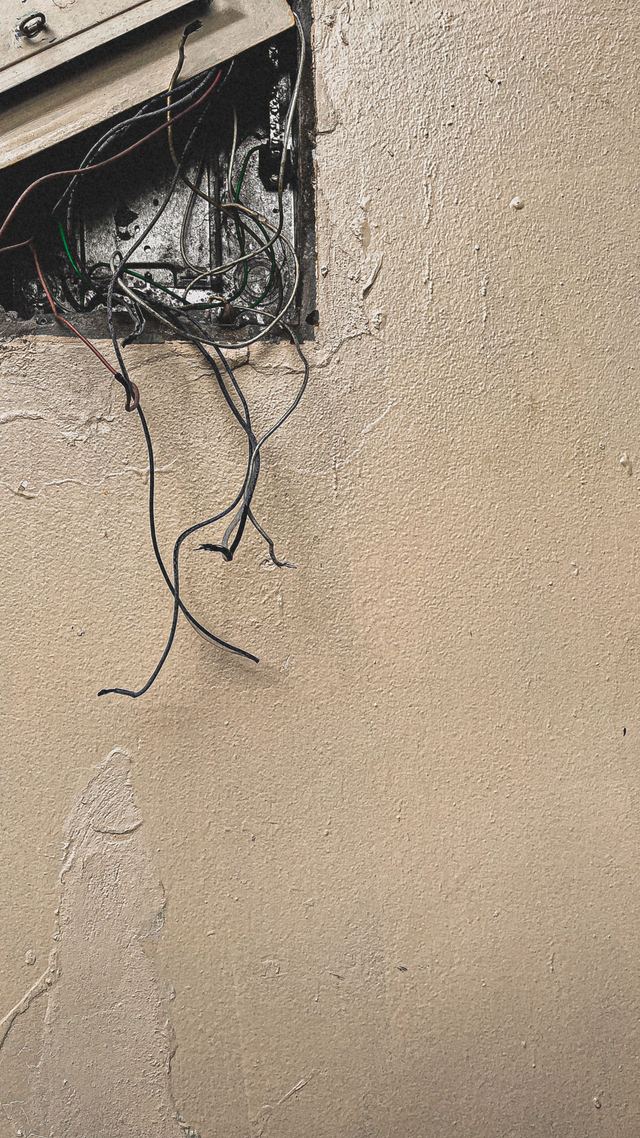
Found brittle or bare cable in the roof space?
Don't handle it or shift it. Perished insulation can crack apart when disturbed and leave live copper showing, so keep people out of that part of the ceiling until an electrician has tested it. A tingle from a switch or tap, or a hot smell you can't trace, is more urgent: switch off at the main switch if it's safe and call an electrician now.
How old wiring gives itself away
Rubber-insulated cable usually shows dark rubber under a cotton or tape covering. With age it goes hard, cracks and flakes off the copper, worst where it's run hot, near light fittings and in roof spaces.
Cloth-covered flex turns up on old pendant lights and some early appliance connections. The outer braid frays and the insulation inside goes brittle.
Early TPS (tough plastic sheathed cable) is the flat cable style most homes still use. It lasts far better than rubber, but runs that were cooked by old downlights, chewed by rodents or joined with tape in the ceiling still need checking.
Other clues are an old fuse board, very few power points, and loose cable lying across the ceiling joists.
Why rubber insulation fails
Rubber was never going to last as long as some of these houses have. Heat and time break it down, and once it's brittle, any movement, like a tradesperson in the ceiling or a rodent nest, can expose the copper.
The danger isn't only shocks. Bare conductors touching each other or the timber can arc, and an arc in a ceiling space can start a fire, often in a house with no RCD to cut the power.
What the electrician does
Look and test
They inspect the cable where it can be seen, then run insulation and earth tests circuit by circuit. The readings show which circuits are failing and which are still sound.
Make it safe
Any dangerous circuit is isolated straight away, even if a few rooms go without lights until it's replaced.
Plan the replacement
You get a written plan: a full rewire, or the worst circuits first. Rubber cable is rarely worth keeping once testing shows it's breaking down.
Certificates
New circuits and rewires are general work, so the finished job should come with a Certificate of Compliance and an Electrical Safety Certificate.
Does old wiring have to come out by law?
There's no date by which old cable must go. WorkSafe's guidance lets an existing installation keep running, and be repaired, while it isn't unsafe, and the move to AS/NZS 3000:2018 by 12 November 2026 doesn't change that. With rubber cable, though, whether it's unsafe is exactly what testing answers.
In a rental, landlords and tenants can't do electrical work unless they're registered and hold a current practising licence, so testing and replacing old cable is a licensed electrician's job. A tenant who notices a tingle, a burning smell or a scorched fitting should stop using it and tell the landlord straight away.
What's safe for you, and what's for the electrician
You can
- Look from the ceiling hatch with a torch, and photograph what you see.
- Note any fittings that run warm, look scorched or flicker.
- Keep stored boxes off cables in the roof space.
Leave to a licensed electrician
- Testing insulation and earthing on every circuit.
- Isolating anything unsafe.
- Replacing rubber or damaged cable.
- Upgrading the switchboard to add RCDs.

Where we'd draw the line
If testing found rubber cable on any circuit, we'd replace those circuits rather than patch them, and we'd do it before insulating the ceiling or laying new floors, while access is easy. If the old cable is TPS and tests well, we'd leave it in place and put the effort into RCDs instead.
Want a specialist to sort it?
Tell us the job and your postcode. We match the licence-checked local electrician who does this kind of work, and they call you. No ring-around, and your number goes to them alone.